
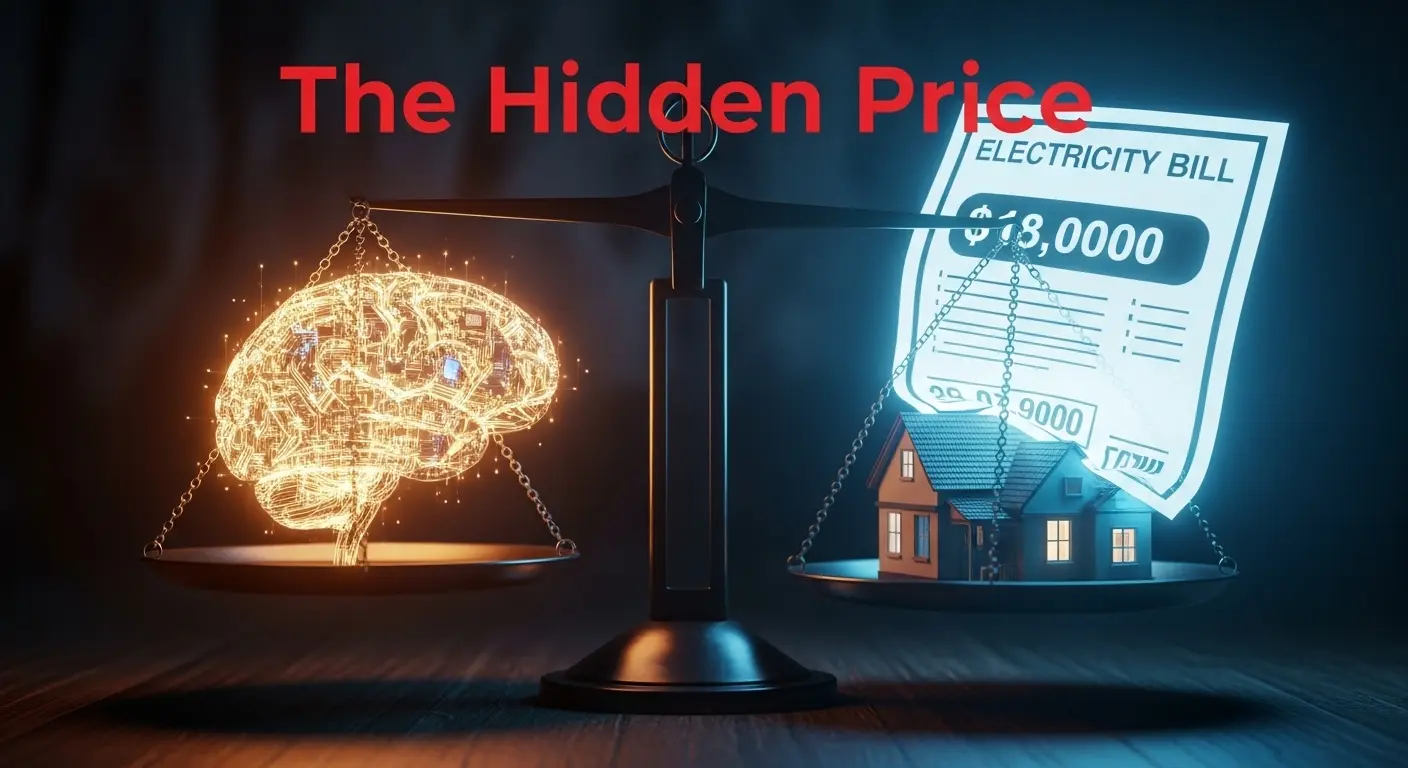
The Hidden Price of Intelligence: How the AI Gold Rush is Re-Engineering Your Power Bill
By Cleaner Energy Solutions Staff
Published February 8, 2026
As the digital world races toward an artificial intelligence-driven future, the physical world is beginning to feel the friction. What began as a “tech boom” in Silicon Valley has transformed into a massive infrastructure overhaul across the American Mid-Atlantic, and for the first time, everyday consumers are seeing the results not in their software, but on their monthly utility statements.
Recent disclosures from the 13-state PJM regional grid reveal a stark reality: the rapid expansion of AI data centers is no longer a corporate footnote—it is a primary driver of rising electricity costs for millions of households. From the suburbs of Northern Virginia to the rural landscapes of Northeast Pennsylvania, the “hidden price” of the AI revolution is finally coming due.
The $23 Billion Capacity Crisis
The scale of the energy demand is unprecedented. In Pennsylvania, PPL Corporation recently disclosed that active interconnection requests for data centers have surged to approximately 20.5 gigawatts. To put that in perspective, that is nearly triple the utility’s current summer peak load of 7.5 GW. If these projects move forward as planned, the region will need to essentially build two new power grids just to keep the servers humming.
This demand has sent shockwaves through the “capacity market”—the system where the grid operator (PJM) pays power plants to be available during peak times. According to the independent market monitor for PJM, data centers have contributed to an estimated $23 billion in capacity procurement costs over the past three auctions alone. Monitoring Analytics estimates that data center demand accounted for roughly 63% of price increases in recent auctions, translating to billions of dollars that are ultimately recovered from ratepayers.
For a resident in Washington D.C. or western Maryland, this isn’t just a technicality. Residential customers have seen their bills jump by an average of $16 to $21 per month, with nearly half of those spikes directly attributable to the capacity market volatility driven by the data center rush.
”Bring Your Own Power”: The Regulatory Hammer
The public backlash has been swift, and legislators are beginning to push back against the idea that “Big Tech” should be subsidized by working families. In early 2026, Pennsylvania Governor Josh Shapiro introduced the Governor’s Responsible Infrastructure Development (GRID) standards. These new rules fundamentally shift the burden of proof onto developers, requiring data center projects to either bring their own power generation to the table or pay for the entirety of the new capacity they require.
“The Pennsylvania taxpayer has had enough,” stated Representative Jamie Walsh, echoing the sentiment of thousands of residents. This “Bring Your Own Power” (BYOP) philosophy is quickly becoming the national standard. On the federal level, Senator Chris Van Hollen’s Power for the People Act of 2026 aims to codify these protections, ensuring that the wealthiest corporations on the planet aren’t constructing their empires at the expense of a family’s ability to heat their home.
Communities at the Crossroads
The tension is most palpable in Northeast Pennsylvania, where WVIA News recently aired a three-day investigative series titled “Data Centers: Deal or Dilemma.” Residents in Luzerne County have mobilized against PPL’s plan to construct 12 miles of 500-kilovolt transmission lines, which would cut through local land purely to serve new facilities.
The dilemma is clear: data centers bring jobs and tax revenue, but they also bring significant environmental and economic strain. Beyond electricity, a single large data center can consume over 300,000 gallons of water per day for cooling—roughly equivalent to the usage of 1,000 homes. As property owners in the Pocono region fight to protect their views and their water tables, the industry is being forced to find a more sustainable middle ground.
A Shift Toward Scalable, Clean Solutions
Despite the friction, the global data center market is still projected to exceed $1 trillion by 2035. The challenge for the next decade will be finding a way to satisfy this “insatiable” demand for power without breaking the national grid or the bank accounts of American citizens. Tech giants are increasingly looking away from the traditional grid and toward self-contained, high-density energy sources that can be deployed directly on-site.
This new landscape of “power-first” site selection is where innovative energy strategies are proving essential. Cleaner Energy Solutions (CES) is leading this transition by offering an alternative to grid dependence through their Small Modular Reactor (SMR) technology. Housed in resilient, hurricane-resistant ellipsoid domes, these modules provide up to 300 MW of carbon-zero power per unit. By allowing data centers to “pay their own way” through dedicated, scalable, and independent energy sources, CES aligns perfectly with the new “GRID” standards—ensuring that the AI revolution can continue without passing the bill to the American ratepayer.
The Road Ahead
The era of cheap, abundant, and “invisible” energy for Big Tech is over. As we move deeper into 2026, the partnership between the energy industry and the tech world will define our economic stability. The success of the AI era won’t be measured by the speed of a chatbot, but by our ability to power that progress without leaving our communities in the dark.