
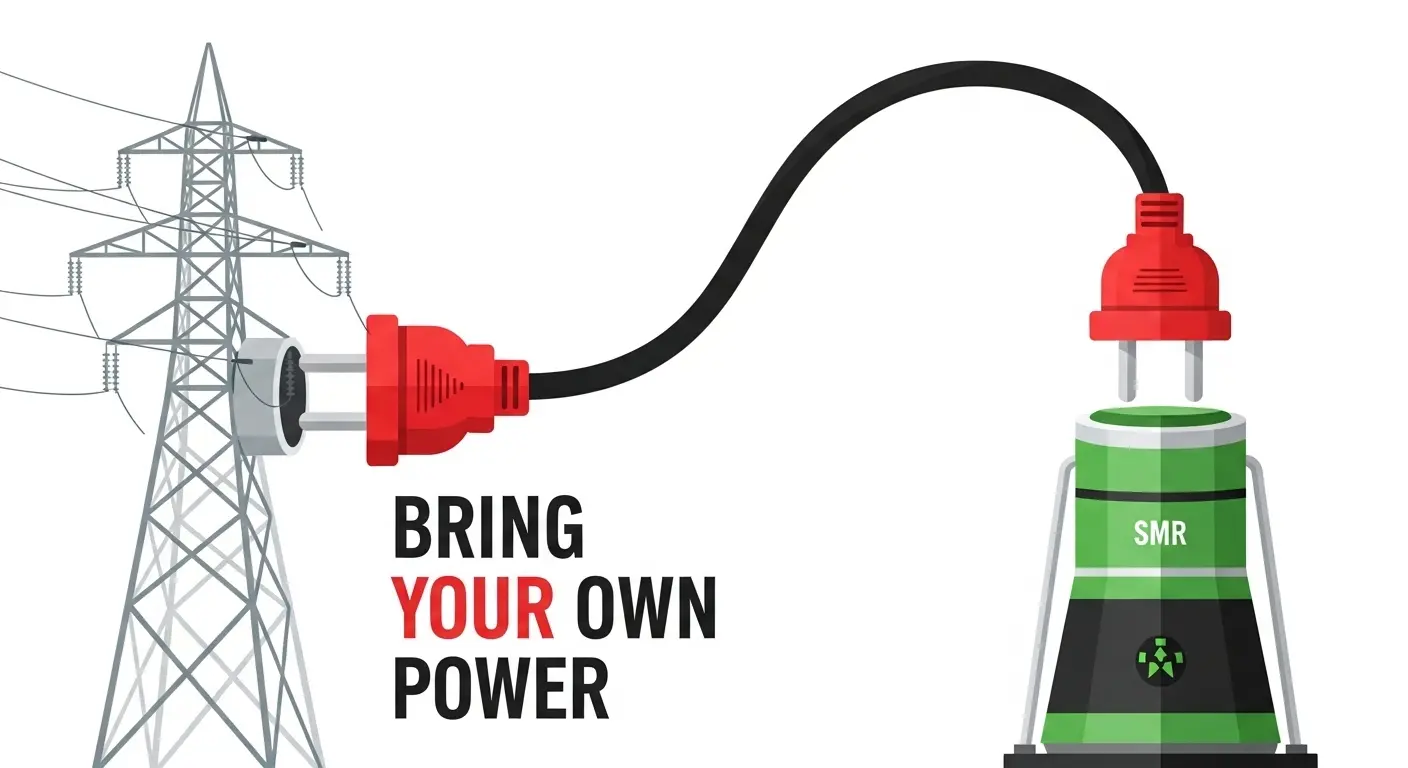
The "Bring-Your-Own-Power" Era: Bloom Energy’s Surge and the AI Energy Evolution
By Cleaner Energy Solutions Staff
Published February 9, 2026
The financial results released on February 5, 2026, by Bloom Energy did more than just satisfy Wall Street; they provided a startlingly clear look at the physical architecture of the artificial intelligence boom. With Q4 revenue jumping 35.9% to $777.7 million and a staggering $20 billion backlog, Bloom’s performance is a “canary in the coal mine” for the national power grid.
As AI hyperscalers like Oracle, Meta, and OpenAI scramble to secure the computing power necessary for the next generation of large language models, they have reached a unified conclusion: the traditional electric grid can no longer keep up. We have officially entered the era of “Bring-Your-Own-Power” (BYOP).
The Validation of a “Power Necessity”
Bloom Energy’s CEO, KR Sridhar, noted that providing onsite power has shifted from a corporate sustainability slogan to a “secular and growing” business necessity. The surge in demand isn’t just about “going green”—it’s about survival. Traditional utilities are facing an interconnection queue nightmare, with some data centers in states like Virginia and Pennsylvania facing 5-to-7-year wait times for a grid connection.
Bloom’s solid oxide fuel cells have become the “first responders” of this crisis. Because they can be deployed in as little as 50 days and operate at 99.9% reliability, they offer hyperscalers a way to bypass the grid entirely. However, as the $500 billion Stargate project and other “super-clusters” come online, the scale of energy required is moving beyond what even the most efficient fuel cells can provide on their own.
The Carbon Trade-Off and the Search for Baseload
While Bloom’s technology offers an immediate fix for reliability, it highlights a secondary crisis: the emissions gap. Most current fuel cell installations rely on natural gas or biogas. While far cleaner than coal-fired plants, they still emit CO2 unless paired with expensive carbon capture or green hydrogen—which is not yet available at the gigawatt scale AI requires.
According to a report from the Lawrence Berkeley National Laboratory, U.S. data centers could consume as much as 12% of the nation’s total electricity by 2028. In the PJM regional grid alone, this demand has already contributed to nearly $10 billion in price increases, costs that are being passed directly to residential ratepayers. The industry is reaching a tipping point where “clean-ish” power isn’t enough; the next phase of the AI race requires massive, zero-carbon, distributed baseload power.
A Regulatory Tailwind for Innovation
The regulatory environment in 2026 has shifted dramatically to meet this need. Under the current administration’s pro-nuclear agenda, the Nuclear Energy Innovation and Modernization Act has been reinvigorated. Recent executive orders have mandated the Nuclear Regulatory Commission (NRC) to streamline licensing for advanced reactors, cutting approval times from years to just 18 months.
This policy shift is designed to treat energy infrastructure like the hardware it supports—modular, scalable, and decentralized. The goal is to quadruple U.S. nuclear capacity by 2050, specifically to fuel the global AI race and ensure American technological dominance.
The “Modular Computer” Evolution of Energy
The success of Bloom’s “energy server” model has proven that the market wants “plug-and-play” power. The logical next step is to apply that same modularity to nuclear energy. By shrinking the footprint and using factory-built components, Small Modular Reactors (SMRs) are becoming the “Dell computer” of the energy world.
This is where the industry is heading: a future where a 300 MW power module can be “racked” next to a data center just as easily as a server. Cleaner Energy Solutions (CES) is leading this final evolution, utilizing advanced SMR technology housed within resilient, hurricane- and earthquake-proof ellipsoid domes. These units deliver the high-density, zero-carbon baseload power that fuel cells hint at but SMRs fulfill. By providing up to 300 MW per module—scalable to 900 MW—CES allows hyperscalers to achieve true carbon-zero operations while remaining entirely independent of a strained national grid, effectively “future-proofing” the AI hubs of tomorrow.
The Path Forward
Bloom Energy’s record-breaking earnings are a victory for the onsite power movement, but they are also a wake-up call. The AI revolution is an energy revolution in disguise. As we move closer to 2030, the winners of the AI race won’t just be the companies with the best algorithms—they will be the companies that secured the most resilient, clean, and independent power.