
PJM’s Dire 60 GW Warning: CES’s Nuclear SMRs Power AI Growth Without the Blackouts or Bill Shocks
By Cleaner Energy Solutions Staff
Published February 8, 2026
The American power grid is currently facing its most significant “red alert” in a generation. On February 6, 2026, PJM Interconnection—the operator responsible for the electricity supply of 65 million people across 13 states—issued a staggering warning: the nation’s largest grid is hurtling toward a 60-gigawatt (GW) power supply shortfall over the next decade.
To put that number in perspective, 60 GW is roughly enough to power 45 million homes. This massive gap between supply and demand isn’t a slow-moving problem; it is already manifesting in the markets. PJM’s December 2025 capacity auction fell 6,625 MW short of its reliability target, the first such shortfall in the organization’s history. For the American consumer and the burgeoning AI industry, this isn’t just a logistical headache—it is an economic and operational crisis that threatens to pull the plug on American innovation.
The AI Strain: Data Centers vs. The American Household
The primary driver of this energy earthquake is the explosive growth of artificial intelligence. In Ohio alone, American Electric Power (AEP) has reported a service queue for data centers exceeding 30,000 megawatts. These facilities are the physical engines of the AI revolution, housing the chips that power projects like Oracle’s “Stargate” and the latest models from OpenAI and Tesla.
However, the grid’s inability to handle this load has sparked a fierce conflict. The Ohio Manufacturers’ Association (OMA) recently appealed to the state supreme court, alleging that utilities are inflating demand forecasts to justify massive infrastructure spending. The stakes are high: estimates suggest that residential customers could face bill spikes of $16 to $21 per month just to fund the transmission upgrades needed for these massive data hubs.
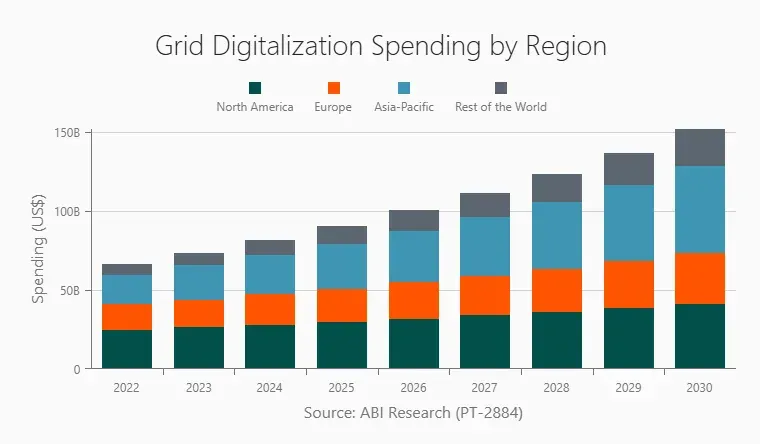 Source: ABI Research
PJM Board Chair David Mills captured the dilemma perfectly: “This is not a yes/no to data centers. This is ‘How can we do this while keeping the lights on and recognizing the impact on consumers?’”
The Failure of Traditional Markets
The crisis has reached the highest levels of government. In early 2026, the White House National Energy Dominance Council joined all 13 governors in the PJM footprint to call for an emergency capacity auction. The traditional market is failing to incentivize new generation at the pace required, while older coal and gas-fired plants are retiring faster than they can be replaced—nearly 58 GW of thermal capacity is at risk of retirement by 2030.
While a recent report by Charles River Associates suggested that utility-owned generation could save customers up to $20 billion annually, the fundamental problem remains: building massive, centralized power plants takes a decade or more. AI moves at the speed of software; the grid still moves at the speed of 20th-century bureaucracy.
Bypassing the Grid: The “Bring-Your-Own-Generation” Revolution
The solution is shifting away from trying to fix the 100-year-old grid and toward a decentralized, modular future. Industry leaders are increasingly adopting a “Bring-Your-Own-Generation” (BYOG) approach. By placing power generation directly at the site of consumption, tech giants can avoid the multi-year interconnection queues and, more importantly, stop shifting the cost of their energy needs onto local families.
This “onsite” revolution requires a technology that is carbon-free, always-on, and resilient enough to withstand the extreme weather events of the 21st century.
CES: The Scalable, Zero-Carbon Fix
As the PJM shortfall looms, the market is looking for a “plug-and-play” solution that offers the density of a traditional power plant with the agility of modern hardware. Cleaner Energy Solutions (CES) has answered this call by pioneering advanced Small Modular Reactors (SMRs) housed within specialized ellipsoid domes. These modules act as the “Dell computer” of the energy world—pre-built, factory-certified, and ready to deploy. Each module provides 300 MW of zero-carbon power, and the design is inherently scalable; facilities can grow to 600 MW or 900 MW simply by adding more domes as data center demand scales.
By utilizing reinforced concrete for maximum safety and hurricane/earthquake resilience, CES’s designs—currently being piloted in regions like Puerto Rico—provide the reliable baseload power needed for AI hubs without relying on the failing national grid. Aligned with the Nuclear Energy Innovation and Modernization Act, CES is positioning the U.S. to achieve energy independence and lead the $500 billion AI infrastructure race without forcing residential ratepayers to foot the bill for industrial growth.
A Future Powered by Innovation
The 60 GW warning from PJM should be seen as a wake-up call, not a death knell. The path forward involves moving beyond the “business as usual” grid model and embracing the modular, resilient technologies that can scale alongside our digital ambitions. By integrating advanced nuclear solutions into the data center roadmap, we can ensure that the light of the AI revolution doesn’t come at the cost of the lights in American homes.