
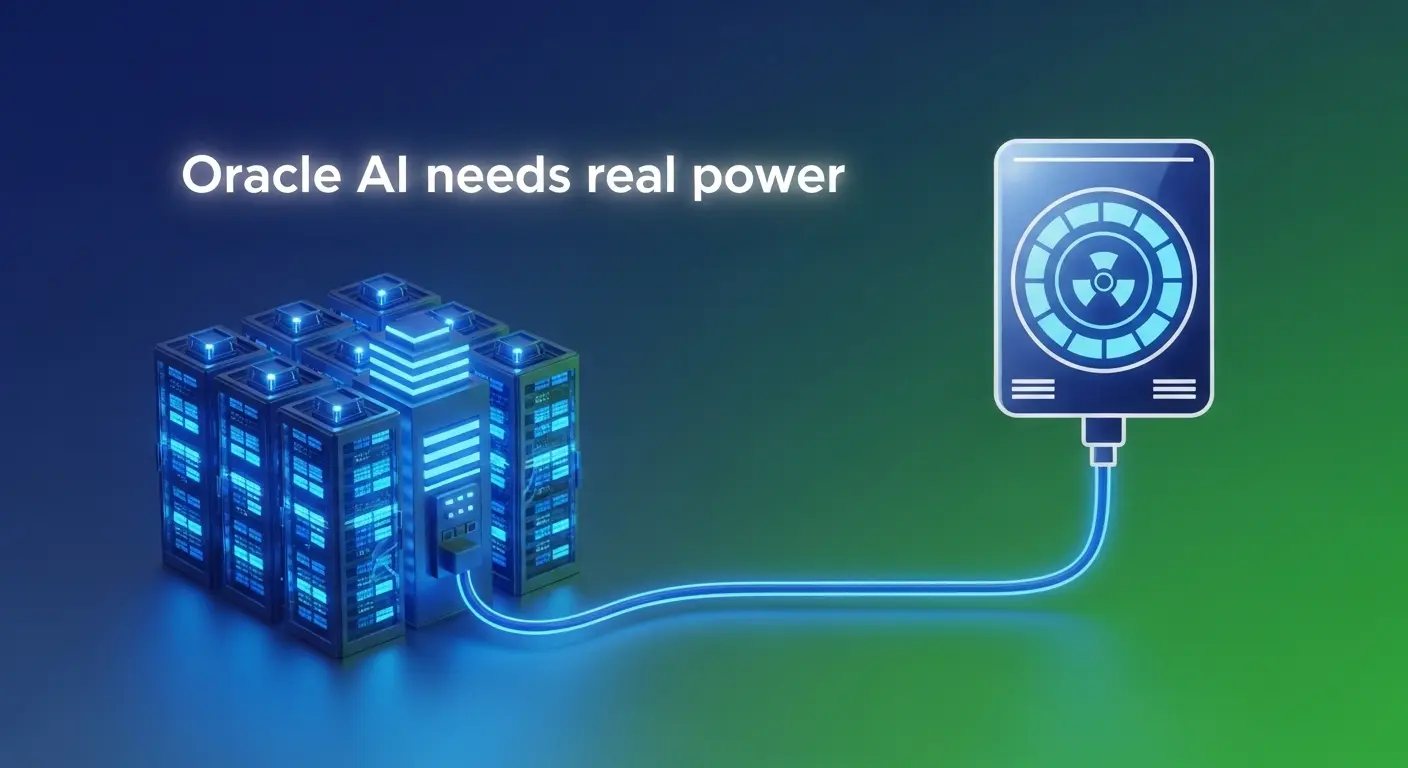
Oracle’s AI Boom Signals Urgent Need for Modular Nuclear Power
By Cleaner Energy Solutions Staff
Published February 8, 2026
The artificial intelligence revolution has officially entered its most capital-intensive phase. This week, technology giant Oracle stunned the financial world by completing a record-breaking $25 billion bond sale, swiftly followed by a $20 billion stock offering. With a staggering $129 billion in orders for the debt issuance alone—the highest investor demand ever recorded for such an offering—the message is clear: the market believes AI is unstoppable.
However, beneath the $45 billion to $50 billion capital raise lies a daunting physical reality. While the funding frenzy is securing the chips and the real estate, it is also sounding a wake-up call for the world’s energy infrastructure. The “Stargate” project—a massive $500 billion joint venture involving Oracle, OpenAI, and SoftBank—is not just a software dream; it is an industrial behemoth that will require an amount of electricity unprecedented in the history of computing.
The Hidden Bottleneck: The Energy Crisis Behind the AI Boom
As Oracle scales its cloud infrastructure to meet the demands of titans like Nvidia, Meta, and xAI, the sheer volume of power required is shifting from a logistical challenge to a systemic crisis. Industry experts estimate that AI-specific data center demand could surge more than thirtyfold over the next decade. For Oracle to honor its $300 billion cloud contract with OpenAI, it must find a way to fuel these “super-clusters” without destabilizing the national grid or falling short of carbon-zero mandates.
The traditional power grid is already gasping for air. In major tech hubs, utilities are warning of multi-year delays for new connections, and regional capacity costs are skyrocketing. When Oracle builds at this scale, they aren’t just adding a building; they are adding the equivalent load of a mid-sized city.
Moving Toward Energy Independence
To maintain their investment-grade credit ratings and operational efficiency, tech giants are realizing that they can no longer rely on 20th-century grid solutions. The current administration’s pro-nuclear agenda and acts like the Nuclear Energy Innovation and Modernization Act are paving a regulatory runway for a more resilient approach: dedicated, on-site power generation.
The industry is moving toward a “Bring Your Own Power” (BYOP) model. This shift ensures that the massive energy consumption of data centers doesn’t drive up costs for local households, while providing the 24/7 reliability that AI model training requires. Wind and solar, while essential, lack the density and consistency needed to fuel a 1,000-megawatt AI hub. This has left a vacuum that only advanced nuclear technology can fill.
From Funding Frenzy to Energy Revolution
This monumental shift is where innovation meets the ground. Oracle’s ambitions serve as a perfect test case for the next generation of modular energy. To power a venture as massive as “Stargate” without a massive carbon footprint, the industry requires a “plug-and-play” energy ecosystem—similar to the modular server architecture that revolutionized data centers themselves.
Cleaner Energy Solutions (CES) is at the forefront of this energy revolution, offering a scalable answer to the AI power dilemma. Our advanced Small Modular Reactors (SMRs) are designed as the “Dell computer” of energy: compact, plug-and-play modules housed in resilient, hurricane- and earthquake-resistant ellipsoid domes. Each module delivers up to 300 MW of carbon-zero power, and our unique design allows facilities to scale seamlessly to 600 MW or 900 MW by simply adding more domes. By segregating modules with reinforced concrete and providing a minimal physical footprint, CES offers the high-density, resilient energy that companies like Oracle and OpenAI need to achieve true carbon-zero operations while bypassing the grid’s limitations.
The Path to Carbon-Zero Ambition
As Oracle prepares to deploy its record-breaking capital, the focus must shift from how much money can be raised to how much power can be safely and sustainably generated. Pilots in regions like Puerto Rico—spanning San Germán, Arecibo, and Morovis—are already proving that modular nuclear can serve as a blueprint for powering critical infrastructure in high-demand environments.
The partnership between Big Tech and advanced energy is the next frontier. By integrating CES’s modular nuclear solutions into the AI data center roadmap, tech giants can ensure that the “Stargate” to the future is powered by clean, reliable, and independent energy, securing America’s position as the world leader in both intelligence and innovation.